Truck Following Distance and Blind Spots: How to Keep Your Space
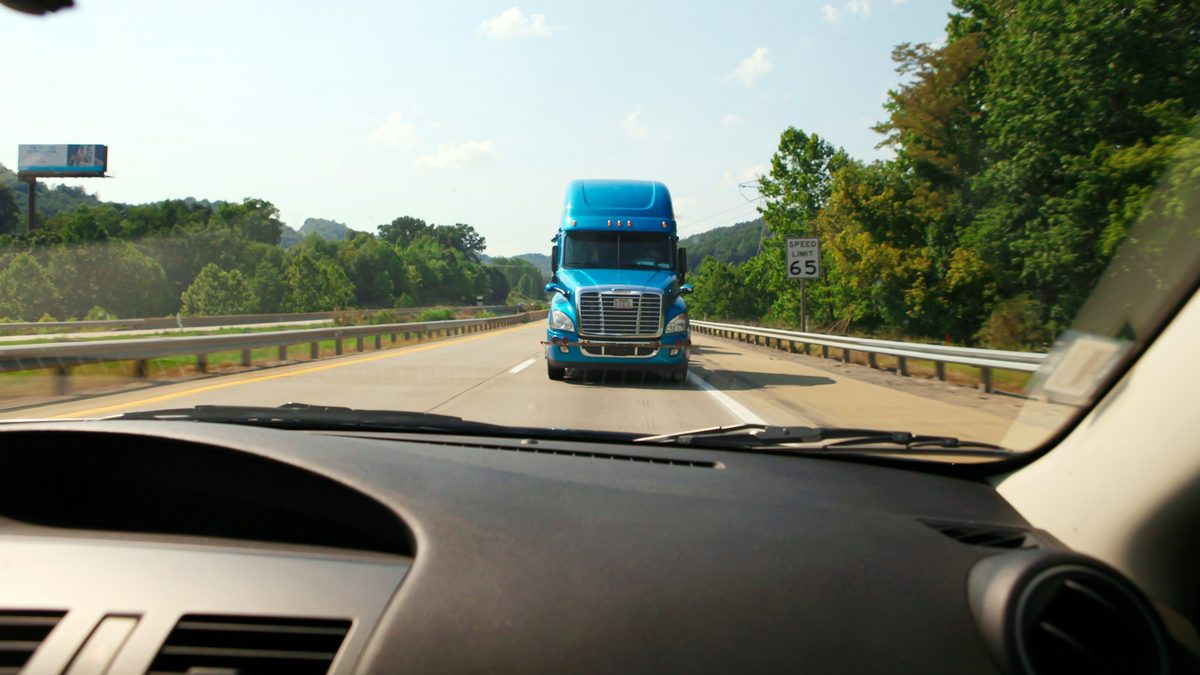
Good truck following distance and blind spots awareness come down to two habits: leave at least one second of space for every 10 feet of rig length, and add a second when you're over 40 mph. Then check your mirrors every 8 to 10 seconds so you always know who is in your No-Zones.
That's the short answer. Below is how to count it, why it matters for your license, and how to manage the space all the way around your truck.
Key takeaways
- Use at least 1 second per 10 feet of vehicle length below 40 mph, plus 1 extra second above 40 mph.
- A truck at highway speed can need up to two football fields to stop, so the space ahead is the space that saves you.
- Your truck has big blind spots on all four sides. Check mirrors every 8 to 10 seconds and scan about 15 seconds ahead.
- Following too closely is a serious traffic violation. Two convictions in a CMV within 3 years means a 60-day disqualification.
Why truck following distance and blind spots matter
A loaded tractor-trailer is heavy, long and slow to stop. FMCSA says trucks at highway speeds can take the length of up to two football fields to stop. The car in front of you can usually stop a lot faster than you can.
The CDL manual puts it plainly. According to crash reports, the vehicle trucks and buses hit most often is the one in front of them, and the most frequent cause is following too closely.
Blind spots are the other half of the problem. Cars slide into your No-Zones all day long. If you don't know they're there, a simple lane change can turn into a crash.
How much following distance does a truck need?
The Ohio CDL Driver Manual gives one good rule: at least one second for each 10 feet of vehicle length at speeds below 40 mph. Above 40 mph, add one more second.
- 40-foot vehicle: 4 seconds below 40 mph, 5 seconds above.
- 60-foot vehicle: 6 seconds below 40 mph, 7 seconds above.
- If your rig is 70 feet long, the same math gives you 7 seconds below 40 mph and 8 seconds above.
Think of these as minimums for dry pavement and good visibility. In rain, snow, fog or heavy traffic, open it up more.
How to count it
Pick a fixed point ahead, like a sign, an overpass shadow or a pavement mark. When the back of the vehicle ahead passes it, start counting: "one thousand and one, one thousand and two." Stop when your front bumper reaches the same spot.
If you came up short, ease off the throttle and count again. After a few weeks it becomes second nature.
What stopping distance really looks like
The CDL manual breaks stopping into three parts: perception distance, reaction distance and braking distance. Under ideal conditions at 55 mph, it says a vehicle will travel a minimum of about 419 feet before it stops.
Weather makes it worse fast. The manual notes that wet roads can double stopping distance and recommends cutting speed by about one-third on a wet road. On packed snow, slow down by half or more. For more on bad-weather driving, read our winter driving tips for truck drivers.
Where are a truck's blind spots?
FMCSA says commercial vehicles have large blind spots around all four sides. Drivers call them No-Zones. The main ones are:
- Right in front of the hood. A small car that cuts in close can disappear below your line of sight.
- Along the right side, running back along the trailer.
- Along the left side, just behind your door and beside the trailer.
- Directly behind the trailer. You can't see a car tailgating you with no mirror view.
FMCSA tells car drivers that if they can't see your face in your mirror, you can't see them. Expect many of them to forget that. Plan for it.
Mirror habits that keep you out of trouble
FMCSA's tips for truck drivers say to check mirrors every 8 to 10 seconds and to scan ahead about 15 seconds. On the interstate, that's about a quarter mile.
Set your mirrors right
Check mirror adjustment before every trip, with the trailer straight. Each mirror should show a little piece of your own rig as a reference point. Remember that convex "spot" mirrors make things look smaller and farther away than they are.
Lane changes
The CDL manual says to check your mirrors four times on a lane change:
- Before you change lanes, to make sure there's room.
- After you signal, to make sure no one moved into your blind spot.
- Right after you start the move, to double-check your path.
- After you complete the lane change.
Signal early and move slowly. A slow lane change gives a hidden car time to honk or back off.
Right turns
Turn slowly. If you have to swing wide, do it as you finish the turn, not at the start. Keep the rear of the trailer close to the curb so no one can squeeze in on your right side.
Managing space on every side
Ahead: This is the space that matters most. Keep your seconds, and look far down the road for brake lights and merging traffic.
Beside: Stay centered in your lane. Avoid running side by side with other vehicles. If traffic is heavy, drop back or pull ahead so the other driver can see you.
Behind: You can't stop people from tailgating you, but you can make it safer. The CDL manual says to increase your following distance, avoid quick changes, signal early and don't speed up. Don't flash your brake lights to "teach" anyone.
Your phone: Federal rules ban hand-held phone use and texting while driving a CMV, except to call for emergency help. Eyes on a screen means eyes off your mirrors.
Following too closely can cost you your CDL
Tailgating isn't just risky. Under 49 CFR 383.51, following the vehicle ahead too closely is a serious traffic violation.
A second conviction for serious violations within 3 years while driving a CMV means a 60-day disqualification. A third means 120 days. Those convictions also show up when a carrier pulls your record. If you're new, our first year truck driver tips cover more habits that protect your license.
Drive with room to spare at JOMA Cargo
JOMA Cargo runs dedicated interstate lanes and Amazon freight with dry van trailers, pulled by Freightliner Cascadia and Volvo tractors. Our dispatch and safety team is there 24/7 when you need a hand on the road.
We're hiring CDL-A drivers. Got questions? Email hiring@jomacargo.com or apply at /driver.
Questions drivers ask
What is the 7-second rule for truck drivers?
It comes from the CDL manual rule of one second for each 10 feet of vehicle length, plus one second above 40 mph. A 60-foot rig needs 6 seconds below 40 mph and 7 seconds above. A longer rig needs more, and bad weather calls for even more space.
How many blind spots does a semi truck have?
FMCSA says large trucks have blind spots on all four sides: in front of the cab, along both sides and directly behind the trailer. Checking your mirrors every 8 to 10 seconds helps you track vehicles moving in and out of them.
Is following too closely a serious violation for CDL holders?
Yes. Under 49 CFR 383.51, following the vehicle ahead too closely is a serious traffic violation. Two convictions within 3 years while driving a CMV lead to a 60-day disqualification, and three lead to 120 days.
How long does it take a loaded semi to stop?
FMCSA says trucks at highway speed can take up to the length of two football fields to stop. The CDL manual says that under ideal conditions at 55 mph, a vehicle travels at least about 419 feet before stopping. Wet roads can double stopping distance.
Sources
- FMCSA Our Roads, Our Safety: Talking Points
- FMCSA: Tips for Truck and Bus Drivers
- FMCSA: Tips for Passenger Vehicle Drivers
- Ohio Department of Public Safety: CDL Driver Manual (HSY 7605)
- eCFR 49 CFR 383.51 Disqualification of drivers
- eCFR 49 CFR 392.80 Prohibition against texting
- eCFR 49 CFR 392.82 Using a hand-held mobile telephone
This article is general information for drivers, not legal or medical advice. Rules change, so check the linked FMCSA and state sources for the current version.